Howdy all;
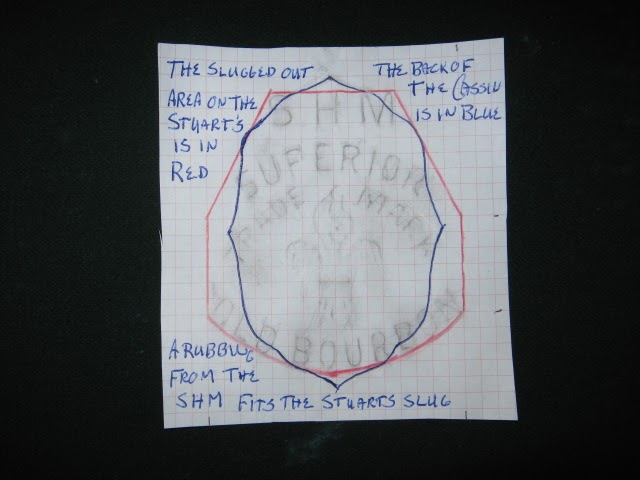
I received an email from Bill Curtis this morning regarding his acquisition of the C. W. Stuarts, and his observation about the similarity of the embossing area coverage on the Stuarts and the embossing pattern on the SHM. In the email, Bill sent a couple of rubbings along with the possibilty of the Stuarts bottle being a reworked SHM mold. An interesting consideration to say the least.
Bill noted,
Hello Bruce I got a Stuart`s last week after looking at it I dont beleive it is made from the Cassin`s mold you can see the slugged out area on the Stuart`s fits the SHM but not the Cassin`s also the Cassin`s has a different bottom and the shoulders are different and if the Stuarts was made from the SHM that would explain the circle on the front of the Stuart`s let me know what you think maybe you can put this on your site.

First off, congratulations to Bill for having the good fortune to have the opportunity to acquire the bottle and have the funds to do it with (both at the same time). Seems like, at least for me, I have money when there's nothing available or visa versa... The Stuarts is a key piece and Bill should be mighty pleased to add it to his collection!
Rather than offering up an opinion in response to Bills email; I'm going to respond with a number of facts and questions. Maybe we can put our heads together and come up with a reasonable group hypothesis.
As we all know, mold modifications were a common place occurrence and we've seen numerous examples where So and So became So and Co. when the second "So" dissolved the partnership. Same goes for Bottled "For" being peened over, replaced by Bottle "By", etc. etc.
We also know that the glass factories maintained an inventory of blank half plate molds. These blank half plate molds were stocked for two purposes. They were stocked in order to allow the mold cutters ready access to blanks with which to fill an order for an embossed mold. They were also used as the back half (plain label side) of a two piece mold bottle.
We also now know, subsequent to the discovery of the Wilmerding & Co sign that documents both east and west coast distribution, that the firm was actively merchandising C. W. Stuarts, McKenna's, United We Stand, SHM (and a few other brands) concurrently.
John Thomas offered a hypothetical dating of this group as follows; Stuarts - ca. 1875 - 1883 / McKenna's - ca. 1874 - 1878 / United We Stand - 1878 - 1883 / SHM - 1874 - 1878. We discovered that the dating of the Untied We Stand was erroneous and that it was originally produced for the 1876 Centennial celebration. The length of the run, however, is still unknown but the commonality of all four bottles dates to ca. 1876 - 1878.
According to Thomas, the Stuarts was blown excusively by C&I of Philadelphia. The McKenna's and the SHM were blown both by C&I and inSan Francisco
We then look at logistics. Assuming that the SHM mold was no longer needed, and that the S.F. glass works decided to created a new half mold for the Stuarts, which makes more sense. Would they 1) Peen out all the embossing and then re-cut the old mold with a new "pattern" or 2) simply take a new fresh half plate mold out of stock and cut in the new "pattern"?
Regardless
Bruce
I received an email from Bill Curtis this morning regarding his acquisition of the C. W. Stuarts, and his observation about the similarity of the embossing area coverage on the Stuarts and the embossing pattern on the SHM. In the email, Bill sent a couple of rubbings along with the possibilty of the Stuarts bottle being a reworked SHM mold. An interesting consideration to say the least.
Bill noted,
Hello Bruce I got a Stuart`s last week after looking at it I dont beleive it is made from the Cassin`s mold you can see the slugged out area on the Stuart`s fits the SHM but not the Cassin`s also the Cassin`s has a different bottom and the shoulders are different and if the Stuarts was made from the SHM that would explain the circle on the front of the Stuart`s let me know what you think maybe you can put this on your site.
First off, congratulations to Bill for having the good fortune to have the opportunity to acquire the bottle and have the funds to do it with (both at the same time). Seems like, at least for me, I have money when there's nothing available or visa versa... The Stuarts is a key piece and Bill should be mighty pleased to add it to his collection!
Rather than offering up an opinion in response to Bills email; I'm going to respond with a number of facts and questions. Maybe we can put our heads together and come up with a reasonable group hypothesis.
As we all know, mold modifications were a common place occurrence and we've seen numerous examples where So and So became So and Co. when the second "So" dissolved the partnership. Same goes for Bottled "For" being peened over, replaced by Bottle "By", etc. etc.
We also know that the glass factories maintained an inventory of blank half plate molds. These blank half plate molds were stocked for two purposes. They were stocked in order to allow the mold cutters ready access to blanks with which to fill an order for an embossed mold. They were also used as the back half (plain label side) of a two piece mold bottle.
We also now know, subsequent to the discovery of the Wilmerding & Co sign that documents both east and west coast distribution, that the firm was actively merchandising C. W. Stuarts, McKenna's, United We Stand, SHM (and a few other brands) concurrently.
John Thomas offered a hypothetical dating of this group as follows; Stuarts - ca. 1875 - 1883 / McKenna's - ca. 1874 - 1878 / United We Stand - 1878 - 1883 / SHM - 1874 - 1878. We discovered that the dating of the Untied We Stand was erroneous and that it was originally produced for the 1876 Centennial celebration. The length of the run, however, is still unknown but the commonality of all four bottles dates to ca. 1876 - 1878.
According to Thomas, the Stuarts was blown excusively by C&I of Philadelphia. The McKenna's and the SHM were blown both by C&I and in
We then look at logistics. Assuming that the SHM mold was no longer needed, and that the S.F. glass works decided to created a new half mold for the Stuarts, which makes more sense. Would they 1) Peen out all the embossing and then re-cut the old mold with a new "pattern" or 2) simply take a new fresh half plate mold out of stock and cut in the new "pattern"?
Personally speaking, based on my research, John Thomas assumed a lot without having the facts to back up his statements. As I've stated previously, John did the best with the research tools that he had available and we owe him a huge debt of gratitude for giving us the foundation of research upon which we've continued to build. And in his defense, a lot of his assumptions made sense at the time based on the documentation that he had available.
Regardless
Bruce
http://www.westernwhiskeytooltopgazette.com/
As far as the point
or seraph in between the T and the S goes in regards to the Stuart's, it
does have one pictured in Thomas. I'm not sure if that example is the C&I or
the S.F. variant. But, according to Bill, the Stuarts was blown only by C&I so it's a moot point. My western McK does not have one but my Miller's, Simmond's
Nabob, Blake's and OPS / Hotaling's all do. I suspect that it may have been an
intentional omission on the McK mold since it is not present on the sign while
the Stuart's on the sign does have it.
Bill sent the following to Denny so thought I'd attach it as well;

___________________________________________________________________________________
C&I above with straight legged "R's" vs. S.F. blown mold variant below.
___________________________________________________________________________________

Hi All;
Thanks for catching
the mistake in my original posting. I had two draft copy's open and mistakenly posted and emailed the rest of
the gang the one with typos and the oops re the SHM being western only. The correct one posted on the tool site. I've now posted
the correct one along with a copy of Bills rubbing and a photo of the Wilmerding
sign.
I've got two SHM's
at this time. Both came from the same base and front and back half molds. Quite
obviously blown at different times, though since one is a rich olive green amber
with the other being an extremely light yellow orange (like the color of a dried
apricot). Both bases are void of glassworks initials so assume they are western. Since their is no plural or possessive words, no seraph is present.
Another consideration is the back half mold. There's the issue of the shoulder logo on the label half of the mold. The K is vastly different from the W&Co. on the SHM, and much additional effort would have been required to peen out and re-cut it as well. But there's no evidence of a rework on the rear half of either. Finally, assuming that the rear are two different half plates, why re-cut only the front half, but not the rear?
Another consideration is the back half mold. There's the issue of the shoulder logo on the label half of the mold. The K is vastly different from the W&Co. on the SHM, and much additional effort would have been required to peen out and re-cut it as well. But there's no evidence of a rework on the rear half of either. Finally, assuming that the rear are two different half plates, why re-cut only the front half, but not the rear?
Take
care & Happy Thanksgiving!
Bruce
Bill sent the following to Denny so thought I'd attach it as well;
I went to Ken`s this morning and got a rubbing of the C&I SHM. Here it
is. Can you send it to somebody to post it? I have been trying to figure out how
to down load a picture onto Roger`s site, it is beyond me. You can see there is
a little difference in the size of the C&I embossed area due to the smaller
size of the C&I SHM bottle. It fits the pattern on the back of the Stuarts
better than the S.F. made SHM. The C&I SHM lettering and the 1 has
points/saraphs, and straight legged R's. The SF SHM has curved R's.
Denny replied;
You're right, seems like the C&I SHM lettering fits the area of the
Stuarts back pattern even better than the SF SHM in your original rubbing.
I'll forward this along to the website guys via this email. I'm not sure I
would be successful either in attempting to post your attached picture
correctly.
___________________________________________________________________________________
C&I above with straight legged "R's" vs. S.F. blown mold variant below.
___________________________________________________________________________________