The
Wormser Bros. flasks (
tf-62,
tf-63,
tf-64) are early western glob flasks that are well known to collectors, at least the
Wormser (
tf-63) or Vertical
Wormser is well known. The
Wormser (
tf-63) is probably the most common, most easily obtainable, of the western glob flasks. This is one of the larger, early western flasks. Widely distributed in California and Nevada, and also southern Oregon. Distribution dates on this bottle would be approx. 1868-1872. If I was to venture a guess on a population total of this bottle, I would put the number at 200+. With that many examples floating around, it means you can find a decent example in the $350-500 price range. The typical "character flaws" of this flask are lack of crudeness in the body, weak embossing, and the typical color of this flask is quite an ordinary dark olive amber. So, if you want an example that is whittled, with strong embossing, and in a lighter color, the price just went up!
There are several variations of this particular
Wormser flask. If you are a "variant nut" like some of us are, then you will find it enjoyable to try to obtain the different examples. Hey, with the high prices, all I can afford are
Wormser variations. I am not going to turn this into a exercise in minutiae much like collecting early U.S. coins, did you know there are about 50 varieties of the 1804 half cent!!?? I will consider embossing variations, major mold changes, and in the case of flasks, the type of top will be considered a variety.
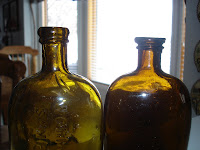
The
Wormser(
tf-63) comes in three variations of the top. What is considered the earliest example has a large double roll top, with the top roll noticeably larger than the bottom roll. These large top examples were once thought to have been blown at the South Stoddard Glass works (see Wilson, Spirits of). I am quite certain that all of the examples of the
Wormser Flasks were blown in San Francisco. Also, there is really no documented indication that this style of top is older or blown earlier than the other two (
tf-63) variations. It's just more popular. In my observation of this variant, it seems like it usually comes with fairly weak embossing. Try to locate one with strong embossing and with decent whittle effect. They are not that easy to come by.
Second variation would be the double roll top that is uniform in size, top roll to bottom roll. These seem to show up more often with stronger embossing, and I have seen this variety more often in lighter shades of orange amber and yellow amber compared to the 1st variant. Again, not that often in a highly whittled state. If you can locate one that is whittled and in color, you've got a nice example.
Third variation would be the single roll top. I have not seen all that many of this style over the years. I have owned two or three and have seen a handful in other collections. One nice whittled example of a single roll (
tf-63) came out of a privy in
Pioche, NV in 1970's, along with some other nice early bottles. All of the
early single roll examples I have seen have been in the same medium to dark olive amber coloration, and I have no documented reason to think they were blown before or after the other two variations. Except for some interesting finds that were made in Ruby Hill, NV.
Digging that area in the early 1990's, before mining started up again in earnest, produced two, maybe three examples of
Wormser(
tf-63) flasks with a very small, pinched single roll top. They were not remarkable in any way except for the
squirrelly top and that they were more of a plain amber color. The problem with these latest single roll finds is that they were found in late 1870's/early 1880's holes. Other bottles in the privies,
Mau sodas, Schneider Drugs, amber beers - not black glass, etc., all point to a time capsule of from 1878-1882. Which corresponds with the boom years of Ruby Hill. So, the question begs, why are
Wormser flasks being used in this town a full 6 to 10 years after Isaac and Simon
Wormser sold the company. It probably has something to do with another change in the partnership that had originally bought out the
Wormser Bros. in 1872. (see Thomas pg. 122 Whiskey Bottles of the Old West) It is interesting that they would still have access to the old
Wormser Bros. bottle mold, and trotted out the old familiar embossed bottle years later. We will just include these newer single roll tops with the originals to avoid too much to think about. Glass manufacture in west changed rapidly in the formative years. In the 1860's and early 1870's quality control of glass color for western blown bottles in practically nonexistent. It is not unusual to find early western fifths and flasks, 1867-1874 or so, in a surprising array of colors. From dark amber to apple green, and almost all combinations in between. Even a couple of examples are known in aqua glass. By the later 1870's to 1880's, the amber
coloration became more standard. The
ambers varied more simply light to dark, and not so much with olive tones. To the trained eye, these newer single roll
Wormser flasks look quite different from the ones of
pre-1872.
The
Wormser (
tf-62) flask is the earliest version of
WORMSER BROS. SAN FRANCISCO flask. It is sometimes
referred to as the horizontal
Wormsers or even the "fat
Wormsers". It
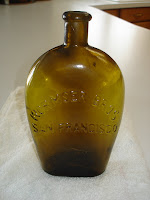
is an awkward, somewhat unwieldy shape, being quite a bit wider through the shoulders than the (
tf-63) flask. These are crudely made bottles, and most likely didn't stand up too well when full of liquid. Possibly the reason they were replaced after a year or two by a more conventional shape. This is the first embossed whiskey flask blown on the West Coast. Circa: 1867-1868. It has been given an earlier date in some publications, but since
Wormser's trade marked their "Golden Sheaf Whiskey" in 1867, that is the date I will use for the bottle. It is
definitely found in towns that were active in 1868. At least ten broken ones and one intact one have been found in Eastern Nevada. A beautiful green example was recently found, broken in place, in Austin, Nev. This bottle would have to be rated very rare, possibly 10-12 intact examples known to exist. The
Wormser(
tf-62) is plagued with small checks and crack

s in the glass due to improper annealing at the glass works. Every example known with either the single roll top or the double roll top have these "in making" annealing cracks. There are three examples known with what has been called a "champagne top". This top is very similar to the eastern blown pictorial flasks of the 1850's -1860's. The champagne top examples of the
Wormser(
tf-62) do not seem to have the annealing problems of the other two styles. I have seen two of the three examples and they appear to be perfect. I am not sure about the third example.
With the distinctly different styles of top, I guess we have three variants of the Wormser(tf-62). Probably no need to worry about collecting all three, as they are nearly impossible to locate. I have seen just a couple for sale in the open market in the past 10years. One, yellow amber, with major damage was offered in 1999 for $2000.00, and in 2006 a beautiful yellow olive, perfect example with the champagne top was sold through Glassworks Auction. It fetched a stunning $26000.00 at auction. That was before auction fees were added!
Most collectors rank the Wormser(tf-62) in the top five of the early western flasks. If we are going by dollar value, or "checkbook ranking", it would have to be ranked at #2. Only the N. Grange flask has sold for a higher price.
The WORMSER BROS. S.F. / FINE OLD COGNAC(tf-64) is another of the extremely rare western glob top flasks, and the final of the three Wormser entries. This bottle was probably distributed for a short time in 1871-1872. There are at least 5, maybe 6 known examples. It is a smaller flask than the other Wormser's, slightly larger than a 1/2 pint. It comes only with a double roll top, and is a fairly heavy, sturdy "banded" style flask. The examples I have seen are similar in color, lighter amber shades with a slight olive tone. It is noted in Thomas' book that a broken pint example of this flask has been found. If anyone has first hand knowledge of that being a fact, please let me know. These flasks have been found in California and Nevada. I found a broken one in the old railroad town of Toano, in eastern Nevada. Putting an estimated value on this bottle is difficult, because there have been very few recorded sales. A very nice example sold at auction in 1996 for $10,000.00. Two more examples were found in 1997 and sold privately, reportedly for similar amounts. See my posting on "whiskey collecting".


